There is nothing more annoying than trying to sleep, work, record, or simply breathe for a minute while noise leaks under the door like it owns the place. If you have been wondering how to soundproof a door, the good news is that you do not always need a full renovation to make a real difference.
Doors are often the weakest point in a room because they are thinner than walls, full of gaps, and sometimes hollow inside. That matters whether you are dealing with hallway chatter, traffic noise, a loud TV, barking dogs, roommates, kids, or the echo of your own voice during video calls.
The trick is understanding what sound is doing. Some noise slips through air gaps. Some passes through a lightweight door slab. Some vibrates through the frame. Once you know which problem you have, the fix becomes much less mysterious.
Table of Contents
- Why how to soundproof a door Starts With Gaps
- What Soundproofing a Door Really Means
- Best Door Soundproofing Methods for Real Homes
- Step-by-Step: how to soundproof a door
- Hollow Core vs Solid Core Doors
- Soundproofing for Bedrooms, Apartments, Offices, and Studios
- Cost, Value, and Financial Insights
- Mistakes That Make Door Soundproofing Less Effective
- Maintenance and Long-Term Noise Control
- FAQs
- Conclusion
Why how to soundproof a door Starts With Gaps
Most people blame the door itself first. Sometimes they are right, especially if the door is hollow and flimsy. But in many homes, the worst noise leak is not the door panel—it is the air around it. Sound travels through openings the same way light does. If you can see light around a closed door, sound is probably coming through that path too.
Noise is not just irritating; it can affect focus, sleep, stress, and hearing health when levels are high enough. NIOSH says its recommended exposure limit for occupational noise is 85 dBA over an eight-hour workday, and OSHA notes that NIOSH recommends less than 15 minutes per day at 100 dBA. That is workplace guidance, not a home design rule, but it shows why repeated loud noise deserves attention.
A door has four main weak spots: the bottom gap, the side jambs, the top gap, and the door slab itself. The bottom gap is usually the biggest offender. Builders often leave it for airflow, flooring clearance, or convenience, but acoustically it behaves like a little tunnel.
So, before buying expensive panels or replacing the whole door, start with the simple question: where is the sound sneaking through?
What Soundproofing a Door Really Means
Soundproofing is often used casually, but true soundproofing means reducing sound transmission from one space to another. In normal homes, the goal is usually not total silence. The goal is quieter, calmer, and more private.
Sound Transmission Class, or STC, is a common rating used to describe how well doors, walls, windows, floors, and other partitions reduce airborne sound. A higher STC number generally means better sound blocking, though STC is better at describing speech-range noise than low-frequency bass, machinery rumble, or vibration.
Definition: sound blocking vs sound absorption
Sound blocking stops noise from passing through a surface or gap. Heavy doors, acoustic seals, sweeps, thresholds, and dense barriers help with blocking.
Sound absorption reduces echo inside a room. Acoustic foam, rugs, curtains, upholstered furniture, and wall panels absorb reflections, but they do not automatically stop noise from entering or leaving.
This distinction matters. Hanging foam squares on a door may make the room less echoey, but it will not fix a one-inch gap underneath. Likewise, a heavy door can block more sound, but if it has no seals, the sound will simply go around it.
The basic soundproofing formula
For doors, the formula is straightforward:
- Seal air gaps.
- Add mass to the door.
- Improve the door sweep and threshold.
- Strengthen the frame and perimeter seal.
- Reduce echo inside the room.
- Replace the door if the slab is too light.
That order is important. Cheap fixes often work best when they are done in the right sequence.
Best Door Soundproofing Methods for Real Homes
Learning how to soundproof a door is easier when you stop thinking about one magic product. There is no single strip, curtain, or foam panel that solves every door problem. The best results usually come from layering a few sensible upgrades.
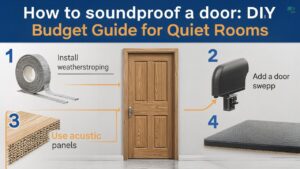
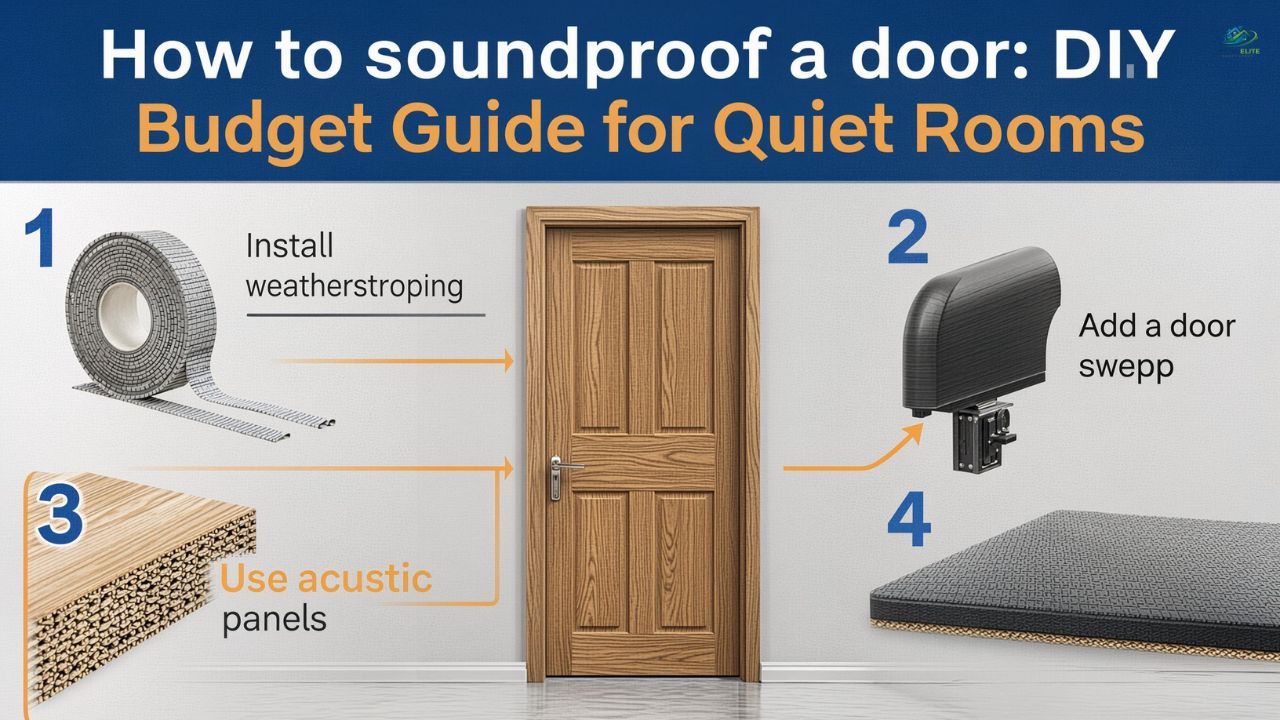
1. Add weatherstripping around the door frame
Weatherstripping is one of the best first steps because it seals the small gaps along the sides and top of the door. It is inexpensive, renter-friendly in many cases, and helpful for drafts as well as sound.
Look for dense rubber, silicone, or acoustic-grade perimeter seals rather than thin foam that collapses quickly. Close the door after installation and make sure the seal compresses evenly. If the door becomes hard to latch, the strip may be too thick or poorly positioned.
2. Install a door sweep
A door sweep closes the gap between the bottom of the door and the floor or threshold. This is often the biggest upgrade for hallway noise, bedroom privacy, and apartment doors.
There are several types: adhesive sweeps, screw-on sweeps, automatic door bottoms, and draft-stopper style sweeps. For sound control, a heavier rubber sweep or automatic door bottom usually performs better than a light fabric draft snake.
3. Use a door gasket kit
A gasket kit is a more complete perimeter sealing system. It typically includes seals for the jambs and head of the frame, sometimes paired with an automatic door bottom. These kits are common in studios, offices, conference rooms, and media rooms where privacy matters.
If you are serious about how to soundproof a door, a quality gasket system is often more effective than sticking random foam around the frame. It creates consistent compression and closes the small leaks that ordinary weatherstripping may miss.
4. Replace a hollow core door with a solid core door
Hollow core doors are common inside homes because they are lightweight and affordable. Unfortunately, they are poor at blocking sound because there is not much mass inside. A solid core door is heavier and usually blocks noticeably more speech and household noise.
JELD-WEN explains that STC ratings above 25 indicate improved sound resistance, while an STC rating of 25 allows normal speech to be easily and distinctly understood through a closed door. It also notes that solid core doors are used to improve quietness compared with lighter interior doors.
A solid core door is not magic by itself. It still needs good seals. But if your current door feels like cardboard when you knock on it, replacing the slab may be the most meaningful upgrade after sealing gaps.
5. Hang a soundproofing blanket or acoustic curtain
A dense moving blanket, acoustic door curtain, or soundproofing blanket can help when you cannot replace the door. This can be useful for renters, temporary studios, dorm rooms, or home offices.
The blanket should cover the entire door area and overlap the edges. A thin decorative curtain will not do much. You need weight and density. The downside is appearance. Some acoustic blankets look practical rather than pretty, so this solution works best in studios, utility rooms, or temporary setups.
6. Add mass-loaded vinyl or a dense barrier
Mass-loaded vinyl, often called MLV, is a flexible dense material used to add mass. It can be attached to a door under a decorative panel, behind trim, or as part of a more serious acoustic treatment.
This can help, but it is not always the prettiest DIY project. MLV is heavy, can be awkward to cut, and may require stronger hinges if you add significant weight. It also works best when combined with door seals.
7. Add a rug near the door
A rug will not block much sound through the door itself, but it can reduce reflected sound and soften noise at the bottom gap area. In bedrooms, nurseries, home offices, and apartments, rugs help the room feel quieter because they reduce echo and footstep sharpness.
If you have hard floors, adding a thick rug on both sides of the door can make the space feel calmer, especially when combined with sweeps and seals.
Step-by-Step: how to soundproof a door
This practical process starts with the cheapest improvements and moves toward bigger upgrades. You do not have to do every step at once. In fact, it is better to make one change, test it, then decide what is still needed.
Step 1: Find the leaks
Close the door during the day and look for light around the frame. Then do the same at night with a flashlight on the other side. Pay special attention to the bottom gap, latch side, hinge side, and top edge.
You can also play music or pink noise outside the room and walk around the inside. Move your ear carefully near the door edges. The loudest points usually tell you where to start.
Step 2: Seal the top and sides
Install weatherstripping or acoustic perimeter seals around the jamb. Clean the surface first so adhesive sticks properly. If using screw-on seals, measure twice and cut carefully.
Close the door slowly and check the latch. A proper seal should touch the door without forcing it out of alignment. If the door does not close, adjust the position instead of slamming it until something bends.
Step 3: Fix the bottom gap
Install a door sweep, automatic door bottom, or threshold seal. This is often where the biggest change happens. If the floor is uneven, an automatic door bottom can be worth the extra cost because it drops down when the door closes and lifts when the door opens.
For renters, an adhesive sweep or removable draft stopper may be the easiest starting point. It will not perform like a professional acoustic threshold, but it is better than leaving the gap open.
Step 4: Add mass if needed
If noise still passes through the door slab, add mass. Options include a soundproofing blanket, MLV, MDF panel, acoustic door panel, or replacing the door with a solid core slab.
This is where many people overspend too early. If you add mass before sealing the edges, you may be disappointed because the sound will keep leaking around the door.
Step 5: Treat the room
Add rugs, curtains, bookshelves, fabric furniture, or wall panels to reduce echo inside the room. This does not replace door sealing, but it improves perceived quiet.
For example, a home office with bare walls, hardwood floors, and a hollow door will sound harsh. Add a rug, curtain, sealed door sweep, and solid core slab, and the room suddenly feels more private and professional.
Step 6: Test the result
Repeat the same sound test you used at the beginning. Stand in the same spot, use the same sound source, and compare honestly. You may not get silence, but you should hear reduced clarity, less sharpness, and better privacy.
Hollow Core vs Solid Core Doors
If someone asks how to soundproof a door and they have a hollow interior door, the conversation usually ends up here. Hollow core doors are convenient, but they are light. Sound loves lightweight surfaces.
Hollow core doors
A hollow core door usually has a thin outer skin with a lightweight internal structure. It is affordable, easy to hang, and common in bedrooms, closets, and hallways. For privacy, though, it is often disappointing. Voices, TV noise, and pet sounds can pass through easily.
A hollow door can still be improved with seals, sweeps, and blankets. But there is a ceiling to what it can do because the door itself lacks mass.
Solid core doors
A solid core door contains a dense interior, often engineered wood or composite material. It feels heavier, shuts more firmly, and blocks more sound.
A solid core door is especially helpful for bedrooms, nurseries, bathrooms, home offices, therapy rooms, podcast rooms, gaming rooms, and shared apartments. Just remember that heavier doors may need longer screws, stronger hinges, or careful adjustment.
Acoustic-rated doors
An acoustic-rated door is designed and tested as a system. It may include a heavy slab, perimeter seals, automatic door bottom, threshold, and sometimes special framing. This is the serious option for studios, music practice rooms, legal offices, medical offices, and other privacy-sensitive spaces.
The cost is much higher, but the performance can be dramatically better when installed correctly. The key phrase is “installed correctly.” Even a high-rated door can underperform if the frame has gaps or the bottom seal is poor.
Soundproofing for Bedrooms, Apartments, Offices, and Studios
Different rooms need different solutions. A bedroom usually needs privacy and sleep comfort. A studio needs sound isolation. An apartment may need renter-safe upgrades. A home office needs clearer calls and fewer interruptions.
Bedroom doors
For bedrooms, start with weatherstripping, a sweep, and a rug. If you can replace the door, choose solid core. Also consider soft furnishings inside the bedroom because they reduce echo and make outside sounds feel less sharp.
A good bedroom soundproofing setup feels invisible. You should not have to wrestle with the door, trip over a draft stopper, or stare at ugly foam every morning.
Apartment doors
Renters need reversible solutions. Use removable weatherstripping, adhesive sweeps, draft stoppers, tension-rod curtains, rugs, and freestanding acoustic panels. Before drilling into the frame or changing hardware, check your lease.
For apartment entry doors, be careful not to block required ventilation, fire safety features, or door operation. Privacy is important, but safety comes first.
Home office doors
A home office usually needs speech privacy. Sealing the door helps stop your voice from carrying into the house and reduces background noise during calls.
Use a solid core door if possible, then add perimeter seals and a sweep. Inside the room, add a rug, curtains, bookcase, or acoustic panels to reduce echo. Your microphone will thank you.
Recording rooms and studios
Studios are harder. Music, bass, drums, and amplified sound need serious isolation. STC ratings do not fully capture low-frequency performance, so a basic sealed bedroom door may not be enough. For a real studio, consider a solid core or acoustic door, gasket kit, automatic door bottom, isolated framing, and possibly a double-door airlock setup. This is where hiring an acoustics professional can save money by preventing weak links.
Cost, Value, and Financial Insights
The cost to soundproof a door can range from a few dollars to several thousand, depending on your goal. A renter trying to sleep better might spend under $100. A homeowner replacing a hollow core door with solid core and acoustic seals may spend several hundred dollars. A professional studio door system can cost much more.
Angi reports professional door weatherstripping can cost about $132 to $436 per door, depending on door size, material choice, prep work, threshold work, and repairs. Its soundproofing guide also notes that door-specific materials such as weatherstripping, thresholds, and acoustic panels generally cost less than full-room soundproofing.
Typical door soundproofing cost table
| Upgrade | Best for | Typical difficulty | Budget level |
|---|---|---|---|
| Draft stopper | Renters, temporary fixes | Very easy | Low |
| Adhesive weatherstripping | Small side and top gaps | Easy | Low |
| Screw-on door sweep | Bottom gap noise | Easy to moderate | Low to medium |
| Acoustic gasket kit | Better perimeter sealing | Moderate | Medium |
| Soundproofing blanket | Temporary studios, renters | Easy | Low to medium |
| Solid core door | Bedrooms, offices, privacy | Moderate | Medium |
| Automatic door bottom | Serious bottom-gap sealing | Moderate | Medium to high |
| Acoustic-rated door | Studios, offices, high privacy | Professional | High |
Budget plan for how to soundproof a door
If you want a practical budget path, start here:
- Seal the door frame.
- Add a door sweep.
- Add a rug near the doorway.
- Test the difference.
- Replace the door with solid core if needed.
- Add acoustic panels or a blanket only if the slab still leaks sound.
This order keeps you from spending money on impressive-looking products that do not address the real weakness.
When spending more makes sense
Spend more if the room has a specific purpose: recording, therapy, confidential calls, shift-work sleep, nursery quiet, music practice, or shared housing privacy. In these cases, better seals and a heavier door can improve daily life enough to justify the cost.
Spend less if your goal is only mild improvement. A sweep and weatherstripping may not create silence, but they can reduce the sharpness of hallway noise and make a room feel more settled.
Mistakes That Make Door Soundproofing Less Effective
Many door soundproofing projects fail because people buy the wrong product first. The internet loves dramatic fixes, but acoustics is stubborn. Sound will exploit the weakest path.
Mistake 1: Adding foam and ignoring gaps
Acoustic foam is for reducing reflections inside a room. It is not a serious sound barrier. If your door has open gaps, foam on the surface will not solve the main problem.
Use foam only when echo is the issue. Use seals, sweeps, mass, and door upgrades when sound transmission is the issue.
Mistake 2: Using thin weatherstripping that collapses
Cheap foam strips can help temporarily, but they often compress, tear, or peel. Once the seal loses contact with the door, the sound leak returns.
Choose durable rubber, silicone, or acoustic seals when possible. They cost more upfront but perform better over time.
Mistake 3: Forgetting the latch side
The latch side often leaks because the door needs enough clearance to close. If the seal is too loose, sound passes through. If it is too tight, the door will not latch properly.
Adjust patiently. The goal is even contact, not brute force.
Mistake 4: Making the door too heavy for the hardware
Adding MLV, MDF, or heavy panels can overload weak hinges. A sagging door creates new gaps, which defeats the point.
If you add significant weight or install a solid core door, use appropriate hinges and longer screws into framing. A good carpenter can help if the door starts rubbing or falling out of square.
Mistake 5: Expecting one door to fix the whole house
Sometimes the door is not the only path. Sound may travel through walls, vents, floors, ceilings, windows, or shared framing. If you seal the door and still hear noise clearly, investigate the surrounding structure.
This is common with bass, footsteps, plumbing noise, and mechanical vibration. Door upgrades help most with airborne sound like voices, TV, and hallway noise.
Maintenance and Long-Term Noise Control
A quiet door is not a set-it-and-forget-it project. Seals wear down, sweeps drag, hinges loosen, and doors shift with humidity or settling. A quick check every few months keeps the system working.
Check the seals
Open and close the door slowly. Look for crushed, torn, or missing weatherstripping. If the seal has flattened permanently, replace it. If adhesive is peeling, clean the frame and reinstall it properly.
Watch the sweep
A sweep should touch the floor or threshold enough to block sound, but not so much that it tears or makes the door hard to use. If it drags heavily, adjust it. If you see light under the door, it is not sealing well.
Keep the door aligned
A door that sags or shifts creates uneven gaps. Tighten hinge screws, check the latch, and make sure the door sits square in the frame. Sometimes replacing short hinge screws with longer ones improves stability.
Control noise at the source
Soundproofing works best when paired with quieter habits. Move speakers away from shared walls, use rugs in hallways, add soft-close hardware, place felt pads under furniture, and keep noisy appliances away from bedrooms when possible.
Small choices stack up. A sealed door plus a rug plus softer room surfaces can feel much better than one dramatic fix used alone.
FAQs
Can I learn how to soundproof a door without replacing it?
Yes. Start by sealing the sides and top with weatherstripping, then close the bottom gap with a sweep or draft stopper. Add a rug and consider a dense door blanket if you need more improvement. Replacing the door helps, but it is not always the first step.
What is the cheapest way to soundproof a door?
The cheapest useful approach is usually a draft stopper or door sweep plus weatherstripping. These fixes target air gaps, which are often the biggest source of sound leakage. They are simple, affordable, and usually easy to install.
Does a door sweep really reduce noise?
Yes, especially when there is a visible gap under the door. A sweep helps block the air path that carries hallway voices, TV noise, and general household sound. For stronger results, pair it with seals around the sides and top of the frame.
Is a solid core door worth it for soundproofing?
A solid core door is often worth it if you currently have a hollow core door and need better privacy. It adds mass, which helps block airborne sound. However, it should still be installed with good perimeter seals and a bottom sweep.
Do acoustic panels on a door block noise?
They may help slightly if they are dense enough, but most acoustic panels are designed to reduce echo, not block transmission. If noise is coming through gaps, panels will not solve the main issue. Seal the door first.
What is better: weatherstripping or a soundproof curtain?
Weatherstripping is usually better for stopping sound leaks around the frame. A soundproof curtain or blanket can add mass and absorption, but it works best after gaps are sealed. For most people, use both only if needed.
Can I soundproof an apartment door as a renter?
Yes, but choose removable options. Try adhesive weatherstripping, a removable sweep, a draft stopper, a rug, and a hanging acoustic curtain. Avoid drilling, replacing the door, or modifying fire-rated entry doors without permission.
Why can I still hear noise after sealing my door?
The sound may be traveling through the door slab, walls, vents, floor, ceiling, or windows. Low-frequency bass and vibration are especially difficult. Door sealing helps most with voices and airborne noise, but it cannot fix every sound path alone.
Is total soundproofing possible with one door?
Not usually. A door can be significantly improved, but total silence requires controlling the entire room assembly: walls, ceiling, floor, vents, windows, and door system. For studios or confidential spaces, a professional acoustic plan may be necessary.
How long does door soundproofing take?
Simple weatherstripping and a sweep can often be installed in under an hour. Replacing a door, adding an automatic door bottom, or installing a full acoustic gasket kit takes longer and may require careful fitting or professional help.
Conclusion
how to soundproof a door comes down to a surprisingly simple idea: stop the leaks, add mass where needed, and soften the room around it. You do not need to buy every acoustic product online or turn your bedroom into a recording booth to make life quieter.
Start with the gaps. Seal the top and sides. Fix the bottom. Then decide whether the door itself is too light. If it is, a solid core door or dense barrier can make a meaningful difference. Add rugs, curtains, and soft furnishings, and the room will usually feel calmer almost immediately.
The best part is that you can improve things step by step. Try the low-cost fixes first, listen carefully, and upgrade only where the noise is still getting through. A quieter room is not just a home improvement project. It is better sleep, easier work, calmer conversations, and a little more peace at the end of a long day.