
Open a drawer at an estate sale, dig through a box at a flea market, or wander the back room of a small-town antique shop, and sooner or later you’ll bump into a small wooden picture frame covered in tiny notched pyramids of wood. It looks handmade because it is. Layer after layer of chip-carved wood, stacked and glued like a miniature staircase, each edge cut by hand with nothing more than a pocketknife. Most people walk right past it. Collectors don’t.
That object has a name, and it’s one that carries a story most people get wrong from the start: tramp art. If you’ve ever wondered what tramp art actually is, why it looks the way it does, or whether that dusty frame in your grandmother’s attic might be worth something, you’re in the right place. This guide covers the real history behind the name, how to spot a genuine tramp art frame, what makes a tramp art mirror or tramp art box special, why tramp art furniture is such a rare find, and why the popular “hobo art” origin story doesn’t quite hold up.
I’ve spent time researching this craft the way a lot of folk-art fans do: by reading the dealers and historians who’ve spent decades handling the real thing, cross-referencing the myths against the documented facts, and looking closely at what actually survives in collections today. What follows isn’t a repackaged Wikipedia summary. It’s a practical, thorough look at a craft that deserves a lot more attention than it usually gets.
What Is Tramp Art, Really?
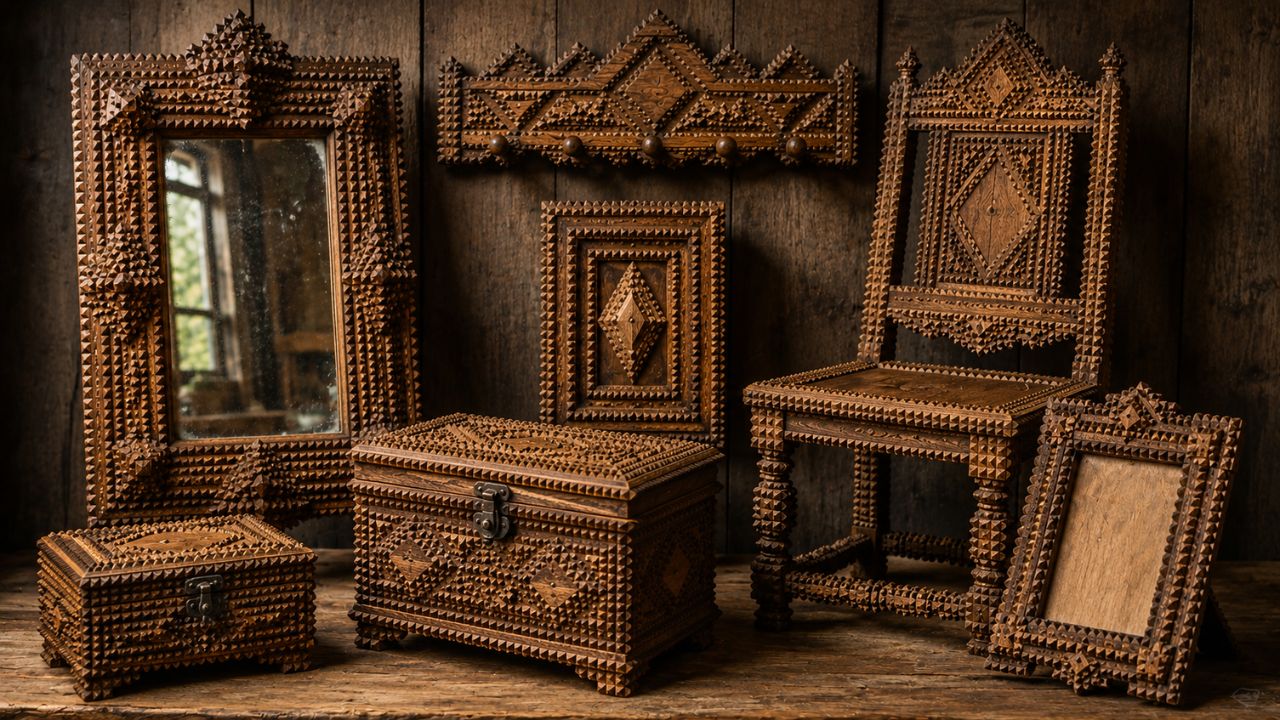
So, what is tramp art? At its core, it’s a style of woodworking built almost entirely from scrap. Small pieces of wood, most often reclaimed from cigar boxes and shipping crates, are notch-carved along their edges and then stacked in layers, each one slightly smaller than the one beneath it, until the whole piece rises into a pyramid-like relief. The technique is called chip carving, and it’s ancient. What’s newer, and specifically American, is how it got applied to cast-off wood by ordinary people with a pocketknife and time on their hands.
The style flourished in the United States roughly between the 1870s and the 1940s, though isolated examples show up earlier and later. It wasn’t confined to one region either. Pieces have turned up in nearly every state, with particularly strong concentrations in German-American communities across Wisconsin, Pennsylvania, and Texas, as well as in Germany and France, where similar chip-carving traditions were already well established.
Here’s the answer to what is tramp art in plain terms: it’s a folk-art movement built on patience rather than money. No formal training, no expensive tools, just a knife, glue or small nails, and hours of repetitive, meditative carving. The finished objects range from tiny jewelry boxes to full bedroom sets, and no two pieces look exactly alike because there was never a pattern book or a set of official rules to follow.
The Materials That Made It Possible
The raw material story matters more than most people realize. After the Civil War, U.S. tax law required cigars to be sold in standardized wooden boxes, and those boxes couldn’t legally be resold or reused for cigars once emptied. Manufacturers used quality woods like cedar and mahogany, often lined with colorful lithographed paper. That meant a steady stream of good, free wood was landing in trash bins across the country. Frugal, practical people picked it up and put it to use.
Shipping crates offered the same opportunity on a larger scale, which is part of why full furniture pieces exist at all. A single cigar box yields enough wood for a small frame or trinket box. A stack of crates gives a carver enough material for a cabinet, a mirror surround, or a chest of drawers.
The Hobo Art Myth: Where the Name Came From (And Why It’s Misleading)
If you’ve heard tramp art called “hobo art,” you’re not wrong to make the connection, but the popular image behind it is largely fiction. The name itself is younger than the craft. It wasn’t coined until 1959, when folklorist Frances Lichten used the term “tramp work” in an article for Pennsylvania Folklife magazine to describe objects made from discarded cigar boxes and assembled with a penknife. The catchier “tramp art” label stuck, and with it came an entire romantic backstory: wandering men, hobo jungles, campfires, carved gifts traded for a meal or a night’s shelter.
It’s a great story. It’s also mostly wrong, and the research bears that out clearly.
Antique dealer and tramp art historian Clifford A. Wallach, who has spent decades documenting the craft and authored multiple books on the subject, has found little evidence that professional wanderers made most surviving pieces. The scale and precision of many objects, especially full-sized furniture, would have required weeks or months of steady, uninterrupted work in one place. That’s simply not compatible with a transient lifestyle. Wallach’s research points instead to farmers, factory workers, carpenters, miners, and shopkeepers, settled men with evening hours to fill, not drifters passing through town.
So why does the hobo art label persist? Partly because it’s memorable, and partly because early antique dealers in the mid-20th century found it easier to sell a piece with a good story attached than one with an honest “unknown maker, unknown circumstances” tag. The name “tramp” itself likely traces back to the German word trampen, meaning to hitchhike or wander, a reference to the old European tradition of journeyman craftsmen traveling to learn a trade before settling down. Somewhere along the way, that etymological thread got tangled up with the American image of the Depression-era hobo, and the myth calcified.
None of this makes the objects less interesting. If anything, knowing that a devoted father, a tired factory hand, or a retired soldier carved a jewelry box for his wife over the course of a winter makes the work feel more personal, not less.
A Short, Honest Timeline
- 1850s — Wooden cigar boxes come into widespread use in the U.S. and Europe.
- 1860s — Civil War-era tax law requires standardized cigar boxes that cannot be reused for their original purpose, flooding households with quality scrap wood.
- 1870s — The earliest documented tramp art pieces appear, coinciding with peak cigar-box availability.
- 1870s–1940s — The craft’s golden era, with production surging again during the Great Depression when frugality and resourcefulness became a necessity rather than a hobby.
- 1959 — Folklorist Frances Lichten publishes an article using the term “tramp work,” which evolves into “tramp art.”
- 1975 — Helaine Fendelman publishes Tramp Art, An Itinerant’s Folk Art, the first dedicated book on the subject, tied to the first museum exhibition on the form at the American Folk Art Museum.
- 2017 — The Museum of International Folk Art in Santa Fe mounts No Idle Hands: The Makers and Myths of Tramp Art, featuring more than 150 pieces and directly addressing the hobo myth for a modern audience.
How Tramp Art Is Actually Made
Understanding the technique makes it much easier to spot authentic pieces later, whether you’re evaluating a tramp art frame, a tramp art mirror, or a full case of tramp art furniture.
Step One: Deconstruction
The maker starts by taking apart cigar boxes or crates, removing nails and separating the wood into flat, workable panels.
Step Two: Cutting Shapes
Panels get cut into basic geometric forms, hearts, stars, diamonds, crosses, or simple rectangles, using a saw or knife.
Step Three: Chip Carving
This is the signature move. Using a pocketknife, the carver notches the edges of each shape with small triangular cuts, usually a repeated V-shaped pattern along every border. It’s slow, repetitive, meditative work, and it’s the single most identifiable feature of the style.
Step Four: Layering
Individual notch-carved pieces are stacked, each one slightly smaller than the piece beneath it, and glued or nailed together to build height and a pyramidal, almost architectural silhouette. Some pieces use dozens of layers on a single element.
An Alternate Technique: Crown of Thorns
Not every piece uses straightforward stacking. A less common but visually striking variant, sometimes called “crown of thorns” joinery, interlocks notched strips of wood the way a log cabin’s corners are joined, layering and overlapping them until they form a radiating, star-like burst. It’s more structurally complex than standard layering and tends to show up on smaller decorative objects rather than large furniture.
Decorative Extras
Many pieces go beyond plain carved wood. Painted layers, contrasting wood tones, small mirrors, mother-of-pearl inlay, and even burnt matchsticks arranged to mimic additional carving all show up on more ambitious examples. These extra touches are often where a maker’s individual style becomes recognizable, even when his name is lost to history.
Tramp Art Frame: The Most Common Survivor
If you only ever encounter one type of tramp art in your life, it’s probably going to be a tramp art frame. Frames were the entry point for most makers: small enough to finish in a reasonable amount of time, useful enough to be worth the effort, and forgiving enough for a beginner working with a knife for the first time.
A classic tramp art frame builds outward from the opening in stepped, pyramidal layers, sometimes rising an inch or more off the surface. Corners often get extra attention, with small carved hearts, stars, or crosses added as focal points. Because frames were made in such large numbers over such a long stretch of decades, they show the widest range of skill levels of any tramp art category, from crude, uneven first attempts to genuinely masterful examples with dozens of precisely matched layers.
When shopping for a tramp art frame today, look closely at the regularity of the notching. Machine-cut reproductions, and there are plenty on the market now, tend to have suspiciously uniform chips. Hand-carved originals almost always show small variations, slightly different notch depths, a bit of asymmetry, evidence of a human hand working without a jig.
What a Tramp Art Frame Is Worth
Pricing swings enormously based on age, condition, complexity, and provenance. A modest, single-layer frame from the early 20th century might sell for well under a hundred dollars at a general antique shop. A large, elaborately layered example with painted accents or documented history can climb into the thousands. As with most folk art, condition and originality matter more than sheer size.
Tramp Art Mirror: A Rarer, More Ambitious Form
A tramp art mirror takes everything a frame requires and raises the stakes. Instead of surrounding a small photograph or print, the maker had to build a structure sturdy and large enough to support a piece of glass, often while keeping the whole thing balanced enough to hang safely on a wall.
Because mirror glass was more expensive and harder to source than a simple picture, a tramp art mirror often represents a bigger investment of both material and time than a comparable frame. Many surviving examples show more elaborate corner ornamentation, sometimes with small carved shelves or hooks built into the design for holding trinkets, combs, or jewelry, a practical touch that turned a decorative object into a functional dressing-table piece.
Because fewer were made and fewer have survived intact (mirror glass breaks; wood frames don’t), a genuine antique tramp art mirror tends to command a premium over an equivalent frame. Collectors specifically hunting for a tramp art mirror should expect to pay more and should inspect the glass carefully. Original, slightly wavy or foxed glass with age-appropriate imperfections is a good sign; a crisp, perfectly clear modern mirror inserted into an old frame is a common and legitimate restoration, but it does affect value if not disclosed.
Tramp Art Box: The Everyday Masterpiece
Ask any longtime dealer and they’ll tell you the tramp art box is arguably the heart of the entire movement. Jewelry boxes, sewing boxes, cigar-shaped keepsake boxes, humidors, small chests, if it could hold something small and personal, someone made a version of it out of chip-carved cigar-box wood.
Boxes gave makers room to experiment. Drawers, hinged lids, secret compartments, and layered lids topped with a carved heart or star all show up regularly. Many were clearly made as gifts, which explains why hearts are such a dominant motif across the entire category. A heart carved into the lid of a tramp art box wasn’t decoration for decoration’s sake; it was often a direct, unspoken message to whoever received it.
Common Tramp Art Box Styles
| Box Type | Typical Use | Notable Features |
|---|---|---|
| Jewelry box | Storing rings, brooches, small keepsakes | Hinged lid, sometimes a small mirror inside |
| Sewing box | Holding thread, needles, buttons | Multiple compartments or trays |
| Humidor | Cigar storage (fittingly) | Heavier construction, sometimes lined with cedar |
| Dresser box | General vanity storage | Decorative feet, layered lid |
| Trinket box | Small personal items | Compact size, simple layering |
Because boxes were made in such huge numbers and in such varied forms, a tramp art box is often the most accessible entry point for a new collector. Prices for smaller, simpler boxes can be reasonable, while large, multi-drawer, or elaborately decorated examples reach well into the higher end of the market.
Tramp Art Furniture: The Rarest and Most Impressive Category
Full-sized tramp art furniture is where the craft’s ambition really shows. Building a chest of drawers, a wardrobe, a hall tree, or even a full bedroom suite entirely from layered, chip-carved cigar-box and crate wood required an enormous amount of raw material and an even larger amount of patience. These weren’t weekend projects. Some pieces almost certainly took years to complete.
Because of the sheer labor involved, tramp art furniture is far less common than frames or boxes, and it’s correspondingly more valuable. A well-documented tramp art furniture piece, a cabinet, a dresser, a game table, can sell for tens of thousands of dollars at auction when condition and provenance line up. Auction records for standout cabinets and chess sets have reportedly reached the tens of thousands of dollars, reflecting just how rare large-scale, high-quality examples are.
What makes surviving tramp art furniture especially compelling is the glimpse it offers into a maker’s daily life. A carved wardrobe wasn’t just decoration; it was a functional household object that had to hold up to years of actual use while also serving as a showpiece. Finding one today, particularly with any documented family history attached, is a genuine event in the folk-art collecting world.
How to Spot Authentic Tramp Art
Given the style’s growing popularity, reproductions and modern “tramp-art-inspired” pieces are increasingly common. A few practical checks:
- Look at the wood. Cigar box wood is typically thin, often cedar or a similar lightweight softwood, and older pieces sometimes still carry faint printing or lithography fragments on hidden surfaces.
- Check the nails. Hand-cut nails generally point to pre-1880s construction; machine-made nails became standard afterward. A knowledgeable dealer or appraiser can help date a piece this way.
- Examine notch consistency. Hand carving shows natural variation. Perfectly uniform notching usually signals a machine-cut modern reproduction.
- Inspect the glue and joins. Old hide glue and small hand-driven nails look and feel different from modern wood glue and pneumatic staples.
- Weigh it in your hands. Genuine layered pieces tend to be heavier than their size suggests, thanks to the sheer number of stacked wood layers.
If you’re serious about collecting, it’s worth studying the reference books written by recognized specialists in the field before making a significant purchase.
Comparing the Core Tramp Art Categories
| Category | Skill Level Required | Relative Rarity | Typical Price Range |
|---|---|---|---|
| Tramp art frame | Beginner to advanced | Common | Low to mid |
| Tramp art mirror | Intermediate to advanced | Uncommon | Mid to high |
| Tramp art box | Beginner to advanced | Common to uncommon | Low to mid-high |
| Tramp art furniture | Advanced/master | Rare | High |
Why This Folk Art Deserves More Respect
For most of the twentieth century, tramp art sat in an odd corner of the antiques world. It wasn’t fine art, it wasn’t quite mainstream Americana, and the persistent hobo art myth gave it a slightly disreputable, roadside-curiosity reputation that made serious collectors and museums slow to take it seriously.
That’s changed. Researchers like Helaine Fendelman and Clifford Wallach spent decades tracking down makers, dating pieces through hardware and construction details, and building the kind of documented history that folk art scholarship usually reserves for quilts, painted furniture, or decorative pottery. Major institutional recognition, including the American Folk Art Museum’s early exhibitions and the Museum of International Folk Art’s 2017 show, has helped reposition tramp art as a legitimate, historically significant American craft tradition rather than a novelty.
What keeps drawing people back to it isn’t just the craftsmanship, though that alone is impressive given the primitive tools involved. It’s the intimacy. Every tramp art frame, mirror, box, or piece of furniture was made by hand, for a reason, usually personal: a gift, a keepsake, a way to fill quiet evening hours with something productive. That combination of skill and sentiment is hard to fake, and it’s exactly why the category continues to gain collector interest today.
Frequently Asked Questions
What is tramp art made from? Tramp art is almost always made from reclaimed wood, most commonly cigar boxes and wooden shipping crates. The wood is cut into shapes, chip-carved along the edges, and layered together with glue or small nails.
Is tramp art the same as hobo art? The two terms are often used interchangeably, but the connection to actual hobos is largely a myth. Research from folk art historians suggests most makers were settled tradespeople, farmers, and laborers rather than wandering transients, even though the “hobo art” nickname has stuck in popular use.
How old is a typical tramp art piece? Most authentic pieces date from the 1870s through the 1940s, with production peaking again during the Great Depression. Pieces from before the Civil War’s cigar-box tax laws are essentially nonexistent.
Is tramp art valuable? It can be. Simple frames and small boxes are often affordable, while large, elaborately carved furniture pieces or documented works by identified makers can sell for thousands of dollars, sometimes far more at specialty auctions.
How can I tell if my tramp art frame is real? Check for hand-carved irregularities in the notching, examine the nail type and wood, and compare the construction to reference examples in specialist books or museum collections. When in doubt, a folk-art appraiser can help confirm authenticity.
Why do so many pieces feature hearts and stars? These motifs were popular personal symbols. A heart typically signaled affection, often carved as a gift for a spouse or loved one, while stars and crosses carried decorative, patriotic, or religious meaning depending on the maker.
Can you still find tramp art at flea markets and estate sales? Yes. Frames and small boxes turn up regularly at estate sales, flea markets, and general antique shops. Furniture and mirrors are considerably harder to find and usually surface through specialist folk-art dealers or auction houses.