I redid my living room three times before it finally felt right. The first attempt looked like a furniture showroom — stiff, matchy, and somehow cold despite the throw pillows. The second try went too far the other way and ended up cluttered. It wasn’t until I started treating the room like a place people actually sit in, rather than a photo I wanted to take, that things clicked.
That’s the thing about living room decor ideas you find online — half of them are styled for a camera, not for a Tuesday night with popcorn on the couch. This guide is different. It’s built around what actually holds up after the photographer leaves: layout choices that make conversation easier, color palettes that don’t date in two years, and a few traditional living room touches that never really go out of style.
Whether you’re working with a rental apartment or a house you’ve owned for a decade, you’ll find living room ideas here you can start on this weekend, plus a few that are worth planning out properly.
What People Are Really Searching For When They Look Up Living Room Ideas
Before getting into the room itself, it helps to know what you’re actually after. Most people typing “living room ideas” into a search bar fall into one of three camps:
- They just moved and have a blank box to fill
- They’re bored of a space that “works” but doesn’t feel like them anymore
- They’re chasing a specific look — often a cozy traditional living room decor style or something more elegant traditional living room ideas they saw on Pinterest
Knowing which camp you’re in changes everything. A blank-box decorator needs furniture and layout first. A refresh decorator usually needs color, texture, and a few statement pieces. The aspirational decorator needs a style framework they can apply room by room. Keep your own goal in mind as you read — it’ll save you from buying things that don’t actually solve your problem.
Start With Layout, Not Decor
I know it’s tempting to jump straight to paint swatches, but layout is where most living rooms quietly fail. A gorgeous sofa in the wrong spot still feels off.
The Conversation Circle Rule
Interior designers talk about the “conversation circle” — arranging seating so people can talk without raising their voices or craning their necks. As a rough guide, no two seats in a main seating area should be more than 8 feet apart.
A few practical layout tips:
- Pull furniture away from the walls, even by a foot. Floating a sofa creates a more intimate room design than pushing everything to the perimeter.
- Use a rug to “anchor” the seating group — front legs of furniture should sit on the rug, not float off it.
- Leave at least 30 inches of walking space between furniture pieces so the room doesn’t feel like an obstacle course.
- If your living room interior design has to double as a hallway, angle furniture slightly to create a clear path instead of fighting the traffic flow head-on.
Small Living Room? Don’t Shrink the Furniture
A common mistake in small rooms is buying tiny furniture to “save space.” It usually backfires — the room ends up looking like a dollhouse instead of feeling bigger. One or two well-scaled pieces, with breathing room around them, almost always reads larger than five small ones crammed together.
Living Room Color Schemes That Actually Wear Well
Color is where most living room decor ideas live or die. A trendy color can feel fresh for six months and dated for the next five years. Here’s what tends to hold up.
| Palette | Mood | Works Best In |
|---|---|---|
| Warm white + walnut | Calm, timeless | Small or low-light rooms |
| Sage green + cream | Soft, grounded | Traditional and transitional rooms |
| Charcoal + brass | Moody, elegant | Larger rooms with good natural light |
| Terracotta + ivory | Warm, inviting | South-facing rooms |
| Navy + camel | Classic, masculine-leaning | Studies, dens, formal living rooms |
If you want a quick way to test a color before committing, paint a large poster board instead of the wall directly. Move it around the room across a full day — morning light and evening lamp light change a color more than most people expect.
Traditional Living Room Ideas: Why the Classics Still Work
There’s a reason traditional living room style hasn’t disappeared, even as trends cycle through mid-century, boho, and minimalist phases every few years. A traditional style living room is built on proportion, symmetry, and materials that age well — qualities that don’t really go out of fashion.
What Defines a Traditional Living Room
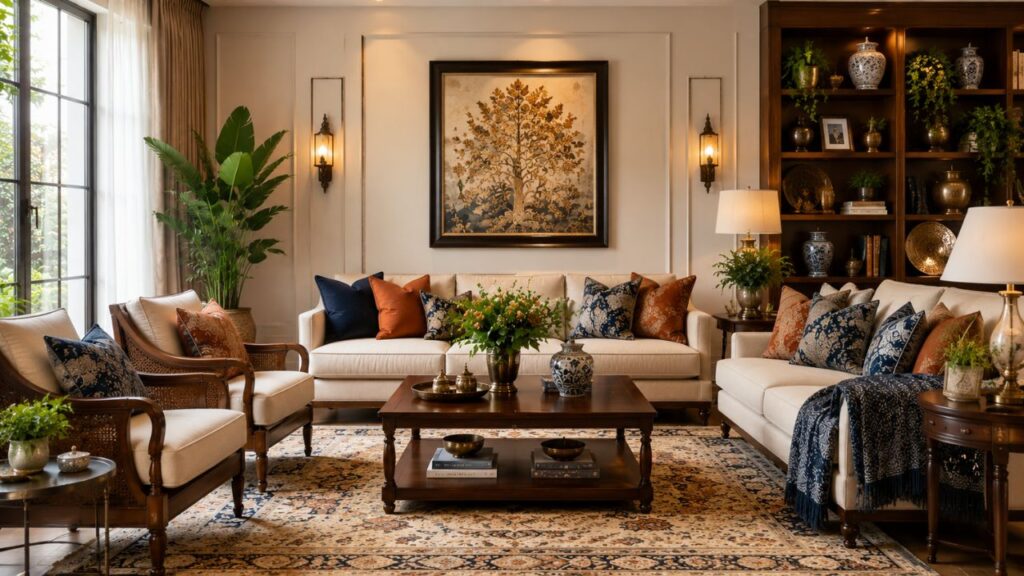
If you look at pictures of traditional living rooms, a few patterns repeat:
- Rolled-arm or camelback sofas, often in a solid or subtly patterned fabric
- Wood furniture with visible grain — cherry, mahogany, or walnut tones
- Symmetrical arrangements: matching lamps, matching side chairs, a centered mantel
- Layered textiles — drapery, an area rug, throw pillows in coordinating but not identical patterns
- Brass or bronze hardware and light fixtures
- Crown molding, wainscoting, or paneled detail where the budget allows
A classic living room idea doesn’t mean stuffy. The best traditional rooms feel collected, not staged — like the pieces arrived over years rather than from a single delivery truck.
Cozy Traditional Living Room Decor on a Real Budget
You don’t need a full renovation to get cozy traditional living room decor. Start with:
- A textured area rug in a muted floral, trellis, or oriental-inspired pattern
- A pair of table lamps with fabric shades instead of one overhead fixture — traditional rooms rely on layered lighting
- A tufted or skirted ottoman as a coffee table substitute; it softens the room instantly
- Heavier drapery in linen or velvet, hung high and wide to make windows look larger
- A gallery of framed art in matching or coordinating frames, hung at eye level
Warm Traditional Living Room Lighting
Lighting makes or breaks a warm traditional living room. Skip the single bright overhead bulb. Instead, aim for three light sources at different heights: a floor lamp, a table lamp, and either sconces or a dimmable chandelier. Warm-toned bulbs (2700K to 3000K) read as cozy; anything bluer starts to feel clinical, which works against the traditional mood you’re going for.
Elegant Traditional Living Room Ideas for a More Formal Feel
If you’re after elegant traditional living room ideas rather than a casual den look, lean into:
- Damask or stripe upholstery on accent chairs
- A statement mirror with an ornate frame above the mantel or console
- Drapery puddling slightly on the floor for a more formal silhouette
- A formal dining-adjacent layout if your living room and dining room share sightlines
- Fresh flowers or a single large botanical arrangement as the room’s “anchor” decor piece
Modern Traditional Living Room: Blending Old and New
A modern traditional living room takes the bones of classic style — symmetry, wood tones, layered textiles — and pairs them with cleaner lines and a more neutral palette. Think a camelback sofa in a solid linen instead of a busy floral, paired with a simple iron-and-glass coffee table instead of an ornate carved one. This hybrid look has become one of the more requested traditional living room decor styles because it photographs well without feeling like a period piece.
Building a Room Around What You Already Own
One thing most “living room ideas” lists skip: you probably don’t need to buy everything new. A useful exercise is to pick the one piece in the room you love most — a rug, a chair, a painting — and build the palette and style around it instead of starting from a blank slate. It’s faster, cheaper, and tends to produce a room that feels more personal than one assembled entirely from a single store’s catalog.
Mixing Old and New Pieces
A room with only new furniture often feels like a hotel lobby. A room with only inherited or secondhand furniture can feel dated. The living rooms that feel most lived-in usually mix eras: a vintage wood console next to a contemporary sofa, or a traditional wingback chair against a more modern wall color. This mixing is also one of the easiest ways to make a traditional room feel current without losing its warmth.
Texture: The Most Underrated Tool in Room Design
Color gets all the attention, but texture is what makes a room feel finished in person, not just in a living room background photo. Without varied texture, even a well-chosen color palette can look flat.
Layer in:
- A nubby wool or jute rug against a smoother leather chair
- A linen sofa with a velvet throw pillow
- Matte painted walls against glossy picture frames or brass fixtures
- A wood coffee table next to a metal or glass side table
If a room photographs fine but feels “off” when you’re standing in it, texture is usually the missing piece.
Lighting: Three Layers, Not One
This deserves its own section because it’s the single most common living room mistake. Overhead lighting alone creates flat, unflattering light and makes a room feel like an office. Aim for:
- Ambient light — general room lighting, ideally dimmable
- Task light — a reading lamp near seating, task lighting near a desk if your living room doubles as a workspace
- Accent light — picture lights, a lit bookshelf, or uplighting on a plant
Rooms with all three layers consistently photograph and feel warmer than rooms relying on one ceiling fixture, regardless of the style you’re going for.
A Simple Room Design Photo Checklist Before You Call It Done
Before declaring the room finished, walk through this list — it catches the small things that separate a styled room from an unfinished one:
- Is there at least one item at eye level on the walls (art, mirror, shelf)?
- Does the rug fit the seating group, or is it floating too small in the middle?
- Are there at least two lamp sources besides overhead lighting?
- Is there something living in the room — a plant, fresh flowers, even a faux option?
- Does every surface have breathing room, or is it all covered in objects?
- Would this room still look intentional with the lights off and curtains open?
Room-by-Room Style Matching
Not every home needs one single style throughout. A common approach: keep a more traditional living room near the entry or formal areas, and let bedrooms or a den lean more casual or eclectic. This kind of contrast, when handled with a consistent color thread running through the house, reads as intentional rather than mismatched.
Common Mistakes That Undercut Good Living Room Ideas
- Matching everything too closely. A sofa, chairs, and curtains in the exact same fabric reads as a furniture store display, not a home.
- Ignoring scale. A tiny coffee table in front of a large sectional looks like it shrunk in the wash.
- Skipping window treatments. Bare windows make even a well-furnished room feel unfinished.
- One giant rug rule violation. A rug too small for the seating area is one of the most common — and most fixable — living room mistakes.
- Forgetting the ceiling. A simple light fixture upgrade or a coat of paint on the ceiling can change the whole feel of a room design.
Frequently Asked Questions
What is the difference between traditional and transitional living room style?
Traditional living room style leans into classic shapes, rich wood tones, and symmetry — think camelback sofas and matching lamps. Transitional style borrows that warmth but pairs it with simpler lines and a more neutral, modern color palette, sitting between traditional and contemporary.
How do I make a small living room feel bigger without making it look bare?
Use a few well-scaled pieces instead of many small ones, keep the rug large enough to anchor the seating area, hang curtains high and wide, and lean on light, warm wall colors. Mirrors placed across from a window also help bounce light around.
What colors work best for a cozy traditional living room?
Warm neutrals like cream, walnut brown, and sage green tend to hold up the longest. Deeper tones like navy or hunter green work well as accent colors on an accent wall, drapery, or upholstery rather than across every surface.
Do I need matching furniture for a classic living room idea to work?
No — and most designers would actually advise against it. A few coordinating pieces (same wood tone or similar color family) read as more put-together than fully matched sets, which can feel more like a hotel room than a home.
How often should I update my living room decor?
There’s no fixed rule, but refreshing smaller elements — pillows, a rug, lighting — every couple of years keeps a room feeling current without the cost of a full redo. Larger furniture pieces, especially traditional wood furniture, are often worth keeping for a decade or more since the style doesn’t shift quickly.
What’s a budget-friendly way to start a living room makeover?
Start with layout and lighting before buying anything new — both are free or low-cost and make the biggest visible difference. After that, a rug and new lamp shades typically give the most noticeable update for the lowest cost.
Where to Go From Here
If this guide covered the big picture, a few related topics are worth exploring next: choosing an area rug size for your specific room dimensions, picking a paint sheen for high-traffic living spaces, and building a gallery wall layout that doesn’t look like an afterthought. Each is its own deep rabbit hole, but they all build on the layout and lighting fundamentals covered here.
A good living room doesn’t come from copying a single photo exactly — it comes from understanding the few things (layout, lighting, texture, and a color palette you won’t tire of) that make any style, traditional or otherwise, actually work in real life.
Internal Linking Suggestions
- Pillar page: “The Complete Room-by-Room Home Decor Guide”
- Cluster: “How to Choose the Right Area Rug Size”
- Cluster: “Paint Sheen Guide for High-Traffic Rooms”
- Cluster: “Gallery Wall Layout Ideas”
- Cluster: “Transitional vs Traditional Style: A Side-by-Side Comparison”
- Supporting: “Small Living Room Layout Ideas”
- Supporting: “Lighting Layers Explained: Ambient, Task, and Accent”
Entities Referenced
Pinterest, brass and bronze finishes, mahogany, walnut, cherry wood, linen, velvet, jute, wool, camelback sofa, wingback chair, crown molding, wainscoting, transitional design style
Semantic Keywords Used
room layout, conversation circle, color palette, accent wall, area rug sizing, light layering, gallery wall, upholstery, drapery, furniture scale, secondhand furniture, mixed-era decor, formal living room, casual den
NLP / Conversational Phrases Used
“what people are really searching for,” “here’s what tends to hold up,” “you don’t need to buy everything new,” “this deserves its own section,” “a quick way to test a color,” “before declaring the room finished”